четвер, 24 листопада 2011 р.

This links are not very interesting but they also have place.

I think that these linls would be interesting 4U

Where is my Hero?
http://www.questgarden.com/72/60/1/081205162959/t-index.htm
This link is not very interesting but students have possibility to meditate. The main question have a deep meaning and force them thinking.

Unraveling the Underground Railroad
http://www.questgarden.com/88/01/4/091112091643/index.htm
Students will become individuals involved in the Underground Railroad (slaves, slave owners, conductors, Northerners) and will come together and discuss this important historical event. It is interesting link for those who study history and try not to forgot about our past. They have chance to delve into the history and do not repeat the mistakes that time...

We all Scream for Ice Cream
http://www.questgarden.com/72/16/0/081106092511/
The students will be studying "How To Make Ice Cream" and will complete a chart of the ice cream making process. It's very positive, sunny and interesting WebQuest for students just to make fun! I like it!!!=)

If you are interesting in poetry it's a good link for u =)

Phenomenal Woman by Maya Angelou
Pretty women wonder where my secret lies.
I'm not cute or built to suit a fashion model's size
But when I start to tell them,
They think I'm telling lies.
I say,
It's in the reach of my arms
The span of my hips,
The stride of my step,
The curl of my lips.
I'm a woman
Phenomenally.
Phenomenal woman,
That's me.

I walk into a room
Just as cool as you please,
And to a man,
The fellows stand or
Fall down on their knees.
Then they swarm around me,
A hive of honey bees.
I say,
It's the fire in my eyes,
And the flash of my teeth,
The swing in my waist,
And the joy in my feet.
I'm a woman
Phenomenally.
Phenomenal woman,
That's me.

Men themselves have wondered
What they see in me.
They try so much
But they can't touch
My inner mystery.
When I try to show them
They say they still can't see.
I say,
It's in the arch of my back,
The sun of my smile,
The ride of my breasts,
The grace of my style.
I'm a woman

Phenomenally.
Phenomenal woman,
That's me.

Now you understand
Just why my head's not bowed.
I don't shout or jump about
Or have to talk real loud.
When you see me passing
It ought to make you proud.
I say,
It's in the click of my heels,
The bend of my hair,
the palm of my hand,
The need of my care,
'Cause I'm a woman
Phenomenally.
Phenomenal woman,
That's me.

Charlotte Bronte

Passion by Charlotte Bronte
SOME have won a wild delight,
By daring wilder sorrow;
Could I gain thy love to-night,
I'd hazard death to-morrow.

Could the battle-struggle earn
One kind glance from thine eye,
How this withering heart would burn,
The heady fight to try !

Welcome nights of broken sleep,
And days of carnage cold,
Could I deem that thou wouldst weep
To hear my perils told.

Tell me, if with wandering bands
I roam full far away,
Wilt thou, to those distant lands,
In spirit ever stray ?

Wild, long, a trumpet sounds afar;
Bid me­bid me go
Where Seik and Briton meet in war,
On Indian Sutlej's flow.

Blood has dyed the Sutlej's waves
With scarlet stain, I know;
Indus' borders yawn with graves,
Yet, command me go !

Though rank and high the holocaust
Of nations, steams to heaven,
Glad I'd join the death-doomed host,
Were but the mandate given.

Passion's strength should nerve my arm,
Its ardour stir my life,
Till human force to that dread charm
Should yield and sink in wild alarm,
Like trees to tempest-strife.

If, hot from war, I seek thy love,
Darest thou turn aside ?
Darest thou, then, my fire reprove,
By scorn, and maddening pride ?

No­my will shall yet control
Thy will, so high and free,
And love shall tame that haughty soul­
Yes­tenderest love for me.

I'll read my triumph in thine eyes,
Behold, and prove the change;
Then leave, perchance, my noble prize,
Once more in arms to range.

I'd die when all the foam is up,
The bright wine sparkling high;
Nor wait till in the exhausted cup
Life's dull dregs only lie.

Then Love thus crowned with sweet reward,
Hope blest with fulness large,
I'd mount the saddle, draw the sword,
And perish in the charge!
Memory Of Sun by Anna Akhmatova
Memory of sun seeps from the heart.
Grass grows yellower.
Faintly if at all the early snowflakes
Hover, hover.

Water becoming ice is slowing in
The narrow channels.
Nothing at all will happen here again,
Will ever happen.

Against the sky the willow spreads a fan
The silk's torn off.
Maybe it's better I did not become
Your wife.

Memory of sun seeps from the heart.
What is it? -- Dark?
Perhaps! Winter will have occupied us
In the night.
Thunder by Anna Akhmatova
There will be thunder then. Remember me.
Say ‘ She asked for storms.’ The entire
world will turn the colour of crimson stone,
and your heart, as then, will turn to fire.

That day, in Moscow, a true prophecy,
when for the last time I say goodbye,
soaring to the heavens that I longed to see,
leaving my shadow here in the sky.

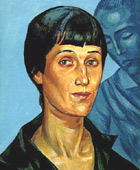
Akhmatova A. A.


Anna Akhmatova
Enlarge Picture

Anna Andreyevna Akhmatova was born Anna Gorenko into an upper-class family in Odessa, the Ukraine, in 1889. Her interest in poetry began in her youth, but when her father found out about her aspirations, he told her not to shame the family name by becoming a "decadent poetess". He forced her to take a pen name, and she chose the last name of her maternal great-grandmother. She attended law school in Kiev and married Nikolai Gumilev, a poet and critic, in 1910. Shortly after the marriage, he travelled to Abyssinia, leaving her behind. While Gumilev was away, Akhmatova wrote many of the poems that would be published in her popular first book, Evening. Her son Lev was also born in 1912. He was raised by his paternal grandmother, who disliked Akhmatova. Akhmatova protested this situation, but her husband supported his family. She would visit with her son during holidays and summer. Later, Akhmatova would write that "motherhood is a bright torture. I was not worthy of it."

Upon Evening's publication in 1912, Akhmatova became a cult figure among the intelligentsia and part of the literary scene in St. Petersburg. Her second book, Rosary (1914), was critically acclaimed and established her reputation. With her husband, she became a leader of Acmeism, a movement which praised the virtues of lucid, carefully-crafted verse and reacted against the vagueness of the Symbolist style which dominated the Russian literary scene of the period. She and Gumilev divorced in 1918. Akhmatova married twice more, to Vladimir Shileiko in 1918, whom she divorced in 1928, and Nikolai Punin, who died in a Siberian labor camp in 1953. The writer Boris Pasternak, who was already married, had proposed to her numerous times.

Nikolai Gumilev was executed in 1921 by the Bolsheviks, and, although Akhmatova and he were divorced, she was still associated with him. As a result, after her book Anno Domini MCMXXI was published in 1922, she had great difficulty finding a publisher. There was an unofficial ban on Akhmatova's poetry from 1925 until 1940. During this time, Akhmatova devoted herself to literary criticism, particularly of Pushkin, and translations. During the latter part of the 1930s, she composed a long poem, Requiem, dedicated to the memory of Stalin's victims. In 1940, a collection of previously published poems, From Six Books, was published. A few months later it was withdrawn.

Changes in the political climate finally allowed her acceptance into the Writer's Union, but following World War II, there was an official decree banning publication of her poetry and Andrey Zhadanov, the Secretary of the Central Committee, expelled her from the Writer's Union, calling her "half nun, half harlot". Her son, Lev, was arrested in 1949 and held in jail until 1956. To try to win his release, Akhmatova wrote poems in praise of Stalin and the government, but it was of no use. Later she requested that these poems not appear in her collected works. She began writing and publishing again in 1958, but with heavy censorship. Young poets like Joseph Brodsky flocked to her. To them, she represented a link with the pre-Revolutionary past which had been destroyed by the Communists.

Though Akhmatova was frequently confronted with official government opposition to her work during her lifetime, she was deeply loved and lauded by the Russian people, in part because she did not abandon her country during difficult political times. Her most accomplished works, Requiem (which was not published in its entirety in Russia until 1987) and Poem Without a Hero, are reactions to the horror of the Stalinist Terror, during which time she endured artistic repression as well as tremendous personal loss.

Akhmatova also translated the works of Victor Hugo, Rabindranath Tagore, Giacomo Leopardi, and various Armenian and Korean poets, and she wrote memoirs of Symbolist writer Aleksandr Blok, the artist Amedeo Modigliani, and fellow Acmeist Osip Mandelstam. In 1964 she was awarded the Etna-Taormina prize and an honorary doctorate from Oxford University in 1965. Her journeys to Sicily and England to receive these honors were her first travels outside Russia since 1912. Two years before her death at the age of 76, Akhmatova was chosen president of the Writers' Union. Akhmatova died in Leningrad, where she had spent most of life, in 1966.

середа, 9 листопада 2011 р.


Alone
From childhood's hour I have not been
As others were; I have not seen
As others saw; I could not bring
My passions from a common spring.
From the same source I have not taken
My sorrow; I could not awaken
My heart to joy at the same tone;
And all I loved, I loved alone.
Then- in my childhood, in the dawn
Of a most stormy life- was drawn
From every depth of good and ill
The mystery which binds me still:
From the torrent, or the fountain,
From the red cliff of the mountain,
From the sun that round me rolled
In its autumn tint of gold,
From the lightning in the sky
As it passed me flying by,
From the thunder and the storm,
And the cloud that took the form
(When the rest of Heaven was blue)
Of a demon in my view.

  If   
by Rudyard kipling
If you can keep your head when all about you
Are losing theirs and blaming it on you,
If you can trust yourself when all men doubt you,
But make allowance for their doubting too;
If you can wait and not be tired by waiting,
Or being lied about, don't deal in lies,
Or being hated, don't give way to hating,
And yet don't look too good, nor talk too wise:

If you can dream - and not make dreams your master;
If you can think - and not make thoughts your aim;
If you can meet with Triumph and Disaster
And treat those two impostors just the same;
If you can bear to hear the truth you've spoken
Twisted by knaves to make a trap for fools,
Or watch the things you gave your life to, broken,
And stoop and build 'em up with worn-out tools:

If you can make one heap of all your winnings
And risk it on one turn of pitch-and-toss,
And lose, and start again at your beginnings
And never breathe a word about your loss;
If you can force your heart and nerve and sinew
To serve your turn long after they are gone,
And so hold on when there is nothing in you
Except the Will which says to them: 'Hold on!'

If you can talk with crowds and keep your virtue,
' Or walk with Kings - nor lose the common touch,
if neither foes nor loving friends can hurt you,
If all men count with you, but none too much;
If you can fill the unforgiving minute
With sixty seconds' worth of distance run,
Yours is the Earth and everything that's in it,
And - which is more - you'll be a Man, my son!